



Partner
Article
European Union Signs EU-Mercosur Free Trade Agreement
February 5, 2026
1. The EU-Mercosur FTA, the Interim Trade Agreement, and the EU-Mercosur Partnership Agreement
On 17 January 2026, after 25 years of negotiations, the European Union (“EU”) and Mercosur – Argentina, Brazil, Paraguay and Uruguay – signed the EU‑Mercosur Free Trade Agreement (“FTA”). The EU-Mercosur FTA creates the world’s largest free trade zones – encompassing over 700 million consumers.
The EU-Mercosur FTA can enter into force only after the FTA is approved by the European Parliament (“EP”). The EP vote to approve the FTA has been delayed by up to two years because the EP decided to ask an opinion from the Court of Justice of the EU (“Court”) on the legality of certain aspects of the FTA with EU law.
Until the time the Court issues its opinion, the EU will likely decide to provisionally apply part of the EU-Mercosur FTA, dubbed the Interim Trade Agreement (“ITA”). The ITA contains rules on areas of law that are competences of the EU, such as trade in goods, trade in services, non‑tariff barriers, regulation, sustainability, and public procurement.
The remaining part of the EU-Mercosur FTA is dubbed the EU-Mercosur Partnership Agreement (“EMPA”). The EMPA focusses on political cooperation and can only enter into force with approval from all 27 EU Member States.
2. Preferential treatment for goods under the EU-Mercosur FTA
The EU-Mercosur FTA establishes preferential treatment for goods originating in the EU and the Mercosur countries. The FTA provides for the elimination of or reduction in tariffs on more than 90% of bilateral trade in goods.
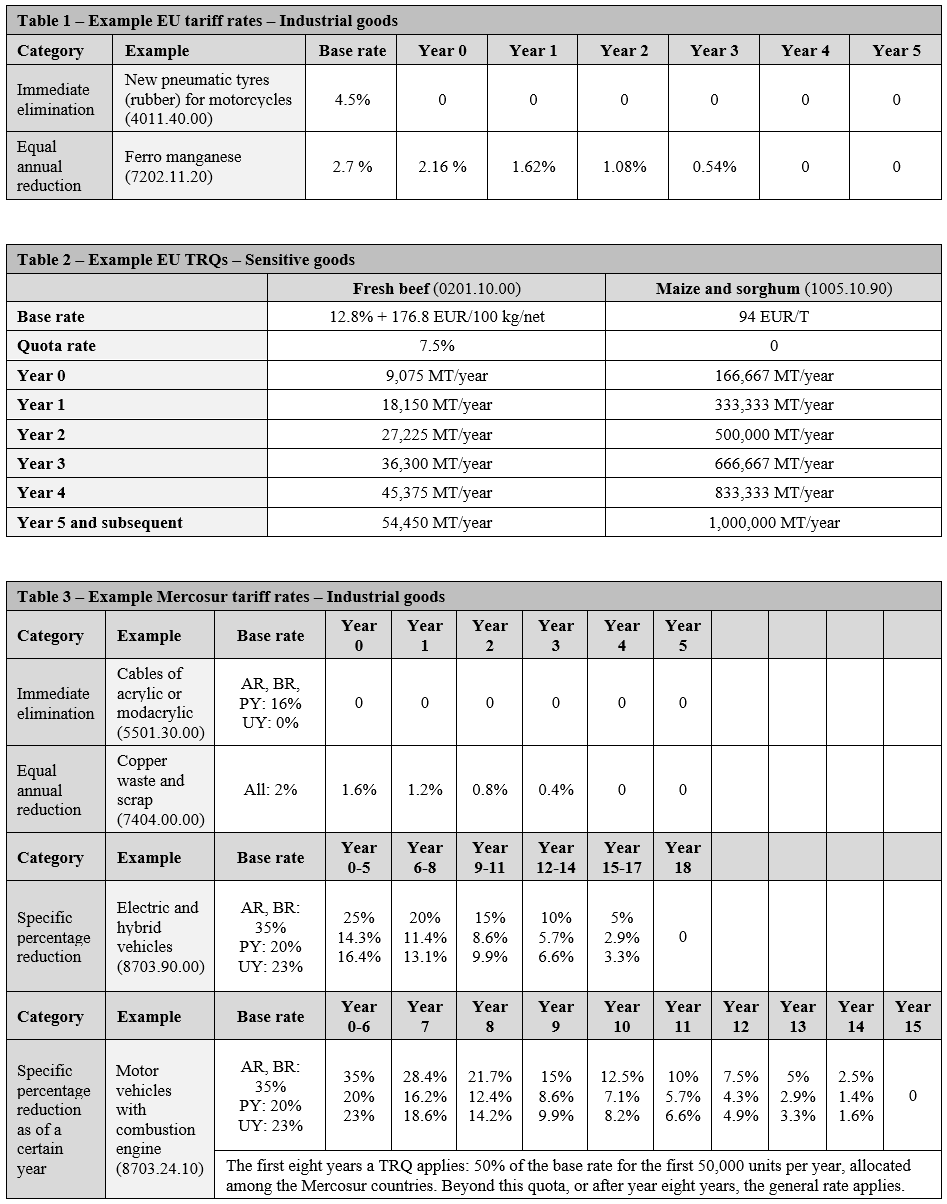
The application of the preferences is complex. As illustrated in Tables 1, 2 and 3 below, depending on the product, the preferences can take the following forms:
- An immediate elimination of tariffs when the FTA enters into force;
- An annual reduction over a number of years (starting when the FTA enters into force or at a later time);
- A specific percentage reduction when the FTA enters into force;
- A specific percentage reduction over a number of years (starting when the FTA enters into force or at a later time);
- A tariff rate quota (“TRQ”), which entails that a certain volume of imports benefits from preferential tariffs, whereas imports exceeding the quota volume are subject to higher tariffs;
- Special arrangements, such as a tariff reduction limited to a specific amount per unit, or a combination of the above preferences.
2.1. Preferences for industrial goods
The EU-Mercosur FTA will eliminate or reduce the majority of EU and Mercosur tariffs on industrial goods that currently apply on EU-Mercosur trade.
Industrial goods originating from the EU that will benefit from tariff preferences in Mercosur countries include cars, machinery, textiles and clothing, and pharmaceuticals. As noted, in certain cases, it will take time before preferences fully apply. For example, Mercosur tariffs on passenger cars with internal combustion engines will be fully liberalized over a period of 15 years. During the first seven years, a transitional quota of 50,000 units, allocated among Mercosur countries, will be opened and will have an in‑quota rate of half the base tariff of 35%. Afterwards, tariffs will be reduced more quickly until they are eliminated. A similar principle applies to battery electric vehicles, with an 18‑year transition period and tariffs reduced immediately to 25%.
Industrial goods originating from Mercosur countries will also benefit from (gradual) tariff preferences. For example, EU tariffs on imports of certain ferroalloys, such as ferro‑silicon, ferro‑silico‑manganese or ferro‑chromium, will be reduced in equal annual stages from the current rates until they are fully eliminated at the end of the transition period.
2.2. Preferences for sensitive goods
For sensitive goods, primarily agri‑food products, such as beef, pork, poultry, sugar, honey, rice, citrus, ethanol, or biodiesel, tariff preferences under the EU-Mercosur FTA will be more limited. Tariff elimination or reduction will be gradual, over an extended period, and partial, through TRQs that cap the volume of imports eligible for preferential tariff treatment.
Goods originating in the EU that are covered by TRQs in Mercosur include certain dairy products (milk powders, cheese, infant formula) and garlic. For example, imports of fresh beef from the EU will be subject to an in‑quota tariff of 7.5%, with the TRQ capped at ~3,000 tonnes in the year the FTA starts applying. The TRQ will be gradually expanded, ultimately leading to a quantitative cap of ~55,000 tonnes as of year five.
Goods originating in the Mercosur countries that are covered by TRQs include certain beef, pork and poultry products, dairy products (milk powders, cheese, infant formula), starch products, maize, sorghum, sweetcorn, rice, sugar products, eggs, honey, garlic, ethanol, and biodiesel. For example, imports of fresh beef from Mercosur countries will be subject to an in‑quota tariff of 7.5%, capped at ~9,000 tonnes in the year the FTA begins to apply, rising to ~55,000 tonnes as of year five. A similar approach applies to frozen beef, with a cap of ~7,500 tonnes in the year the FTA begins to apply, increasing to ~45,000 tonnes as of year five. Imports above the TRQ volumes will remain subject to the current base tariff rates.
2.3. Bilateral safeguard mechanism for sensitive agricultural products
The EU-Mercosur FTA contains a bilateral safeguard clause allowing for a suspension or reduction of preferences. The mechanism enables the EU or Mercosur countries, under certain conditions, to impose temporary protective measures if an unexpected and significant increase in imports causes, or threatens to cause, serious injury to the domestic industry.
To address concerns of EU producers, and to enable the imposition of bilateral safeguards when needed, the EU legislators have provisionally agreed on a regulation implementing the safeguard clause for a closed list of sensitive agricultural products from the EU-Mercosur FTA (“Safeguard Regulation”). The Safeguard Regulation would be the basis for the EU implementation of the bilateral safeguard clause of the FTA and, while it is similar to existing EU safeguard rules, introduces enhanced monitoring, much faster procedures, and simpler triggers for a safeguard investigation.
For completeness, the EU-Mercosur FTA does not limit the EU or Mercosur countries’ ability to apply anti‑dumping, countervailing (anti-subsidy), or multilateral safeguard measures. For example, the existing multilateral EU safeguard measure on certain ferro-alloys will remain in force independently of any preferential tariff treatment under the FTA.
2.4. Geographical indications
Under the EU-Mercosur FTA, the EU and Mercosur countries must implement protection for each other’s geographical indications (“GIs”). GIs ensure that a product carrying a certain product name originates from a specific region and is made using specific knowhow and techniques. For example, Roquefort cheese is produced in Roquefort, France, and aged in the Combalou caves rather than in standard industrial facilities.
A GI is protected under the FTA if it is already protected as a GI in its home territory. The FTA recognizes more than 300 EU food and drink products and over 200 Mercosur products as GIs. While the focus is on agri‑food products, the FTA also recognizes certain non‑agricultural GIs for Brazil and Paraguay, such as traditional textiles or stone and wood craft products.
The FTA foresees for some exceptions, albeit often only temporary. For example, the EU GI Parmigiano Reggiano does not prevent the use of the name Parmesano in Argentina, Paraguay, and Uruguay, if the name Parmesano is, among other conditions, used in good faith.
3. Strengthened access to critical raw materials
The EU-Mercosur FTA strengthens EU access to critical raw materials. Eight of the 34 raw materials that the EU currently classifies as ‘critical’ are found in Mercosur countries: aluminum/bauxite, lithium, natural graphite, manganese, niobium, silicon metal, tantalum, and vanadium.
EU bound tariff rates for most critical raw materials are already zero, but the FTA will further reduce and ultimately eliminate remaining tariffs, such as the current 5.5% tariff on silicon metal. Going further than Article XI GATT 1994, the FTA also introduces a ban on export duties, taxes or other charges. The ban takes effect three years after the FTA enters into force. Brazil is granted an exception and may apply export tariffs on certain listed goods, including mineral products in crude forms, ores and slag, mineral fuels and oils, platinum, ferro-alloys, certain chemicals and specialty metals. However, Brazil must offer the EU a preferential export tariff rate that is at most half of the generally applicable export tariff.
The preferential rules on access to critical raw materials, coupled with additional liberalization of trade in services, are expected to increase EU imports of critical raw materials from Mercosur countries and stimulate investment in, in particular, Brazil and Argentina.
4. What the EU-Mercosur FTA means for businesses
The EU-Mercosur FTA contains significant trade-liberalizing measures that should facilitate and increase trade between the EU and Mercosur countries – in particular trade in goods. As is the case with most EU FTAs, the FTA rules are complex and evolve over time.
Companies who seek to maximally benefit from preferential treatment under the FTA should consider factors such as the applicable rules of origin and the preferential treatment for their products and its conditions and modalities.
Additional Contributors: Josipa Sustic
Authors

Arnoud R. Willems
Partner
Government Matters & Regulation

Bregt Natens
Partner
Government Matters & Regulation

Matthias Vangenechten
Counsel
Government Matters & Regulation

Line Hammoud
Associate
Government Matters & Regulation

Alexandra Volou
Associate
Government Matters & Regulation
Explore King & Spalding

Capabilities
Customs, Tariffs & Other Import Compliance
Capabilities
Special Matters & Government Investigations

The Best and Latest Insights
All in One Place.