



Counsel
Article
UK Revenue Certainty Mechanism for Sustainable Aviation Fuel
February 17, 2026
On 12 January 2026, the UK Government launched its consultation 1 on the design of the revenue certainty mechanism (“RCM”) to support UK production of sustainable aviation fuel (“SAF”). The RCM is intended to complement the UK’s SAF Mandate, which requires aviation fuel suppliers in the UK to gradually ramp-up supplies of eligible SAF.
The Government is inviting responses to its consultation on the key commercial terms for the RCM and the proposed allocation approach for contract awards. Responses are due by no later than 3 April 2026.
Key Design Features of thr RCM
The RCM will be implemented as a contract for difference (“CfD”) under a private law contract with a Government-backed counterparty (likely the Low Carbon Contracts Company that acts as counterparty for the UK’s other renewable and clean energy programmes). The RCM will offer SAF producers a guaranteed “Strike Price” (pre-agreed in the RCM support contract). The Strike Price should be the price required for a SAF producer to make its SAF production project economically viable.
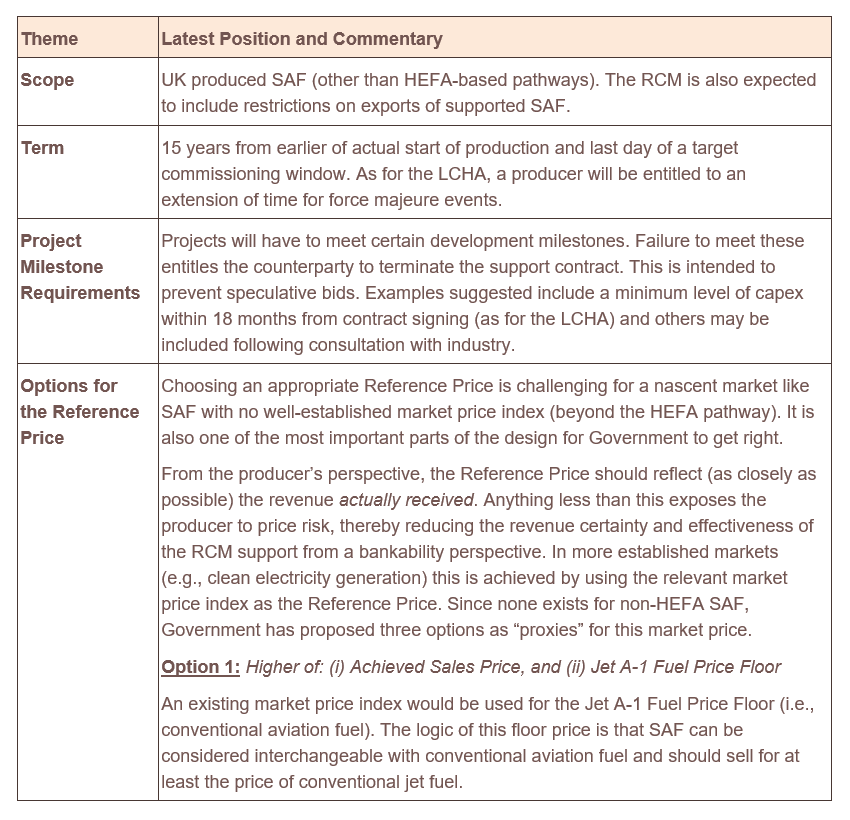
The Government counterparty will pay the difference (the “Difference Amount”) between the Strike Price and the relevant “Reference Price” (when the Reference Price is lower than the Strike Price). This ensures, in theory, revenue certainty for the producer as it will always achieve its Strike Price. When the Reference Price is greater than the Strike Price, the producer pays back the Difference Amount to the counterparty.
The RCM will be available for all SAF production technologies, other than HEFA-based biofuels. This includes power-to-liquids (“PtLs”) (i.e., e-fuels) as well as recycled carbon fuels (“RCFs”) and non-HEFA biofuels. To be eligible for RCM support, the SAF must comply with detailed sustainability requirements, which the Government intends to align with those under the SAF Mandate.
The Government intends to complete all legislation required for the RCM by the end of 2026. Industry could therefore expect the RCM to be launched in 2027, if Government maintains its schedule. The Government has also committed to publishing a timeline and its overall strategy for awarding contracts in the first SAF RCM allocation round (“SAF AR1”).
The RCM will be a critical instrument for de-risking UK SAF production projects. It will make the UK one of the most advanced SAF markets for policy and regulatory instruments that incentivise SAF uptake. The EU has also announced it will launch its own form of supply-side support during 2026, likely through a double-sided auction, to incentivise EU production of aviation e-fuels meeting EU “RFNBO” requirements. 2026 will therefore be a critical year for industry and regulators to ensure the design choices for these supply-side support schemes have the intended effect: kick-starting production of SAF to meet demand-side mandates in the UK and the EU.
Link Between the RCM and the SAF Mandate
The Government’s stated intention is for the RCM to provide supply-side support for volumes of SAF production to facilitate aviation fuel suppliers meeting their SAF Mandate obligations. However, it is worth noting that under the SAF Mandate, supplies of SAF that have benefited from support, including support for precursor inputs (such as hydrogen supported under the Hydrogen Production Business Model (“HPBM”)) are not eligible for counting towards a fuel supplier’s SAF Mandate quota obligations. Since the RCM will work in a similar way to other support schemes such as the HPBM, it would fall within the same restriction. This will need to be clarified (through amendments to the UK SAF Mandate) as part of the process of establishing the legislative footing of the RCM and we expect this to form part of industry feedback as part of the current consultation.
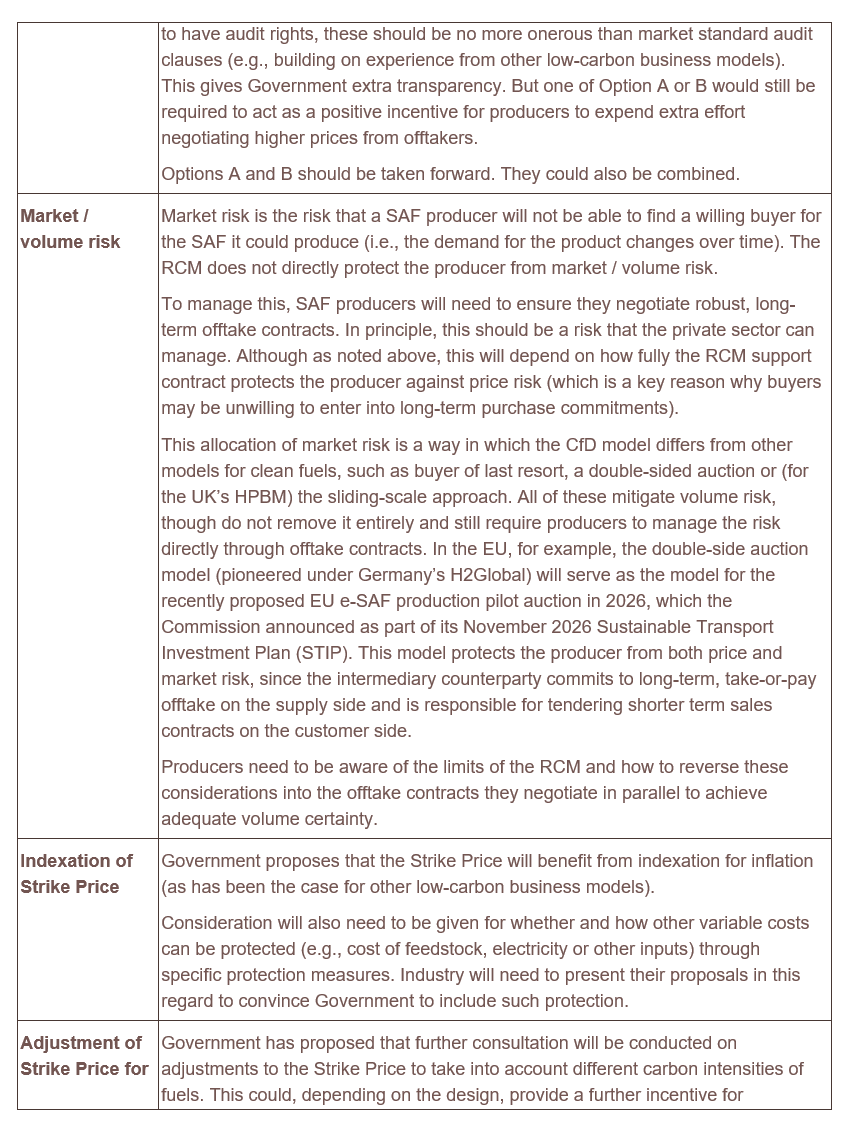
Another important aspect of the relationship between the RCM and the SAF Mandate concerns the Government’s choice of how much volume it will support under the RCM, compared to the volumes needed under the SAF Mandate for fuel suppliers to meet their obligation. Government has not proposed any volume support under the RCM. The industry will need to manage this market risk through entering into supply contracts, ideally long-term commitments, helped by the RCM mitigating associated price risk.
However, contracting practices for aviation fuel typically comprise short-term, often yearly, price and volume renegotiations. It is likely that buyers will need to adapt to longer offtake commitments, helping to de-risk early SAF production projects. But even still, it may be challenging for SAF producers to achieve 15-year upfront offtake commitments with fixed pricing. This means that producers will face residual volume risk and, if Government selects an inappropriate Reference Price, price risk also.
It will be important to get this relationship between the choice of Reference Price and the total volumes supported right. If the volumes of SAF production supported by the RCM, for example, exceed the amount of SAF required to meet the SAF Mandate in any year, then this might have the effect of making offtakers unwilling to commit to SAF purchase contracts (or significantly reduce the cost they are willing to pay above that for conventional jet fuel). This might, as a result, make volume risk much more difficult for producers to manage, unless there is a recognition that (with those market dynamics) the achievable price for SAF will be at or close to the price for conventional jet fuel. Because the SAF Mandate ramps-up gradually, starting relatively modestly, this scenario is quite plausible particular in the early years.
However, what the SAF industry also crucially needs is ambition facilitating scale-up. The RCM should not necessarily be held back just by the volumes that are required in the near future under the SAF Mandate, given the RCM will provide support for 15 years. But to achieve that, Government needs to ensure that the choice of the Reference Price is such as will allow the private sector to manage volume risk through contracting (without exposing the producer to an unmanageable risk of revenue shortfall). Government should also help mitigate the volume risk issue by providing some form of volume support (as was the case under the HPBM).
Consequences of Funding the RCM Through a Levy on Fossil Aviation Fuel Suppliers
The RCM will be funded through a levy on fossil aviation fuel suppliers in the UK (the Government’s consultation on the design of this levy closed in early January 2026). 2 The details of the levy design remain to be seen; but it is expected to be a variable charge, dependant on the size of the Difference Amount payable under the RCM CfD in each relevant period. Conventional aviation fuel suppliers will be responsible for covering these amounts proportionate to their market share of fossil jet fuel supply (using data available from the reporting under the SAF Mandate).3
Fossil aviation fuel suppliers therefore might feel they are incentivised to participate in SAF production projects in the UK to take advantage of the SAF supply that they are (through the levy) ultimately paying for. This would be logical also to shore-up access to supply sources of SAF for purposes of meeting their SAF Mandate obligations.
Companies contemplating such vertically integrated supply chains, however, will need to carefully consider certain design elements of the proposed RCM. In particular, the Government has proposed restrictions on sales of SAF to affiliate offtakers, which is intended to try and ensure the sales price achieved is truly arm’s length. This might create issues for some proposed project set-ups (e.g., where offtakers have an equity stake in the producer benefiting from the RCM). Details of the triggers and scope of this restriction will need to be addressed through the RCM design and we expect industry feedback on this during the ongoing consultation.
In this regard, and in several other areas of the RCM design considerations, the Government reveals a central (and possibly over-emphasised) tenet of its thinking in the design of the RCM: “value for money.” In one instance in the indicative heads of terms, the Government (in relation to restrictions on sales to affiliate offtakers) refers to “value for money for Government”, which is possibly a hangover from the design proposals for other programmes. In other instances, the consultation refers more generally to “value for money of the RCM overall” (or similar). But what does that mean, considering how the RCM will be funded?
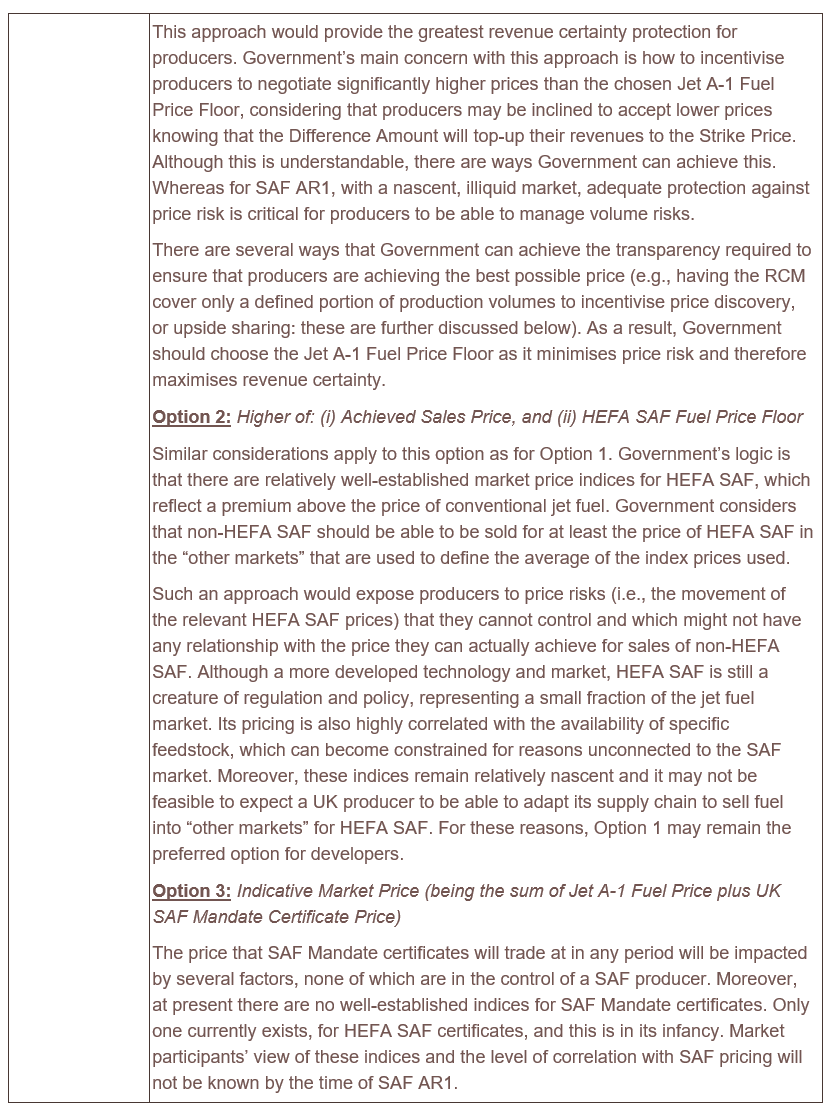
There is one school of thought that, given funding the RCM through the levy on industry, aviation fuel suppliers (as a whole) will be paying the same for SAF, whether through: (i) a higher purchase price for SAF (and therefore lower Difference Amounts, leading to lower levies), or alternatively (ii) a lower purchase price for SAF (with the higher Difference Amounts leading to higher levies). Ultimately, the price that the industry (as a whole) will pay is the price that SAF producers need to make their projects economical: i.e., the guaranteed Strike Price.
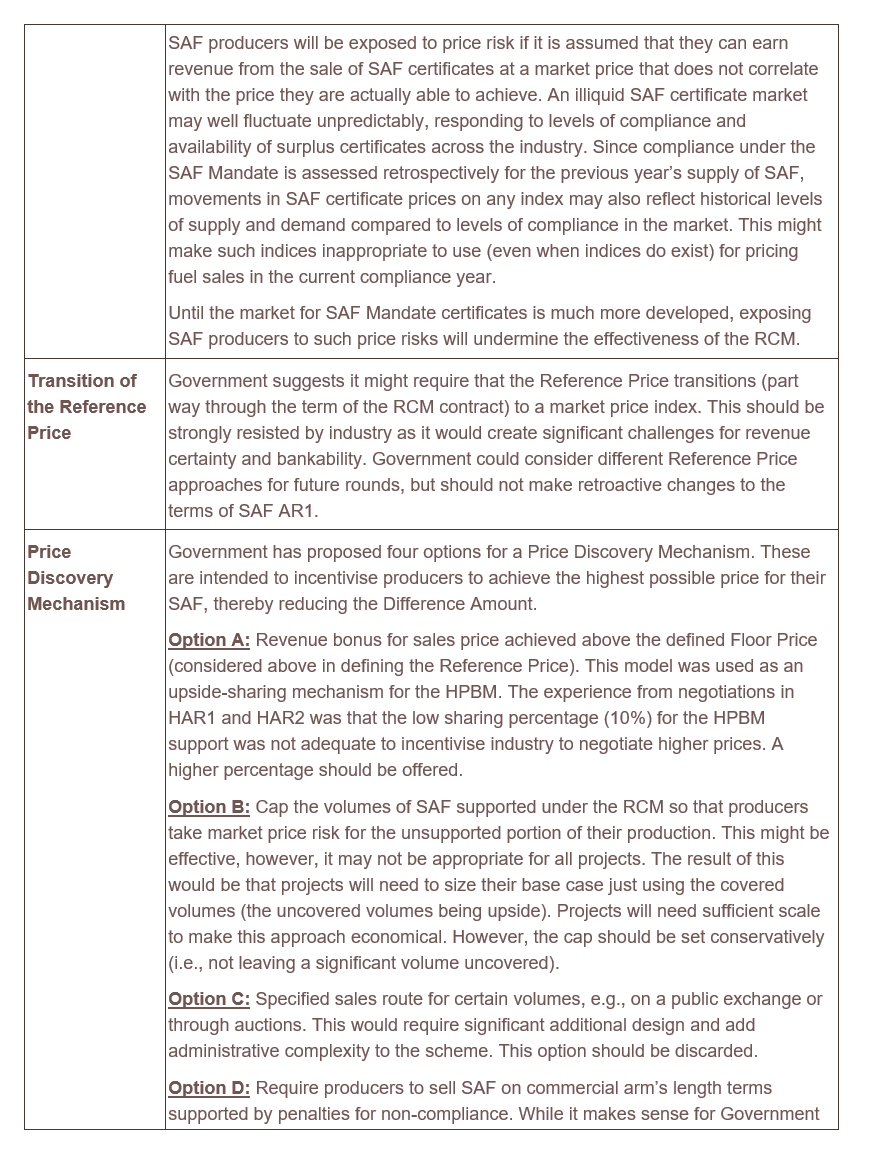
The only way of reducing the overall cost of the RCM scheme (for fuel suppliers, and therefore ultimately for air passengers, assuming these costs largely get passed through in ticket prices) is to reduce the costs of creating new SAF production capacity, by de-risking projects leading to lower development and financing costs. The best way to do this is to maximise the revenue certainty offered by the RCM support contract. Although seeking for the RCM to also achieve transparency and price discovery are legitimate goals, over-emphasising these for SAF AR1 is potentially premature.
Contract Allocation Approach
The consultation also contains Government’s proposal for its contract allocation approach. This indicates that Government will follow a similar approach to the allocation rounds for the HPBM (“HAR”). This would involve a tendered bid process with bilateral negotiations. A bilateral negotiations approach makes more sense than a competitive auction at this stage of the SAF market, since the pool of potential projects remains relatively small and there are diverse technologies (each with different cost profiles) making it difficult to structure a fair auction.
Government has indicated that it will assess tendered prices based on the “normalised strike price” – i.e., comparing prices based on the amount of GHG emissions savings per £. This is important, particularly for PtLs, which can often be the cleanest forms of SAF but typically are more expensive to produce. PtL developers will need to ensure that this proposal is enshrined in the award criteria.
Further details on the award approach will be provided in a Government strategy document. This will need to consider whether and how to ensure that a diverse range of technology pathways can be incentivised, while also not spreading the proposed total RCM support too thinly. If only small amounts of support are awarded to many projects, that reduced scale of support may not be sufficient to allow projects to achieve the necessary economies of scale.
Commentary on the Key Features of the Proposed RCM Design
The below summarises and comments on some of the key features of the proposed RCM design:
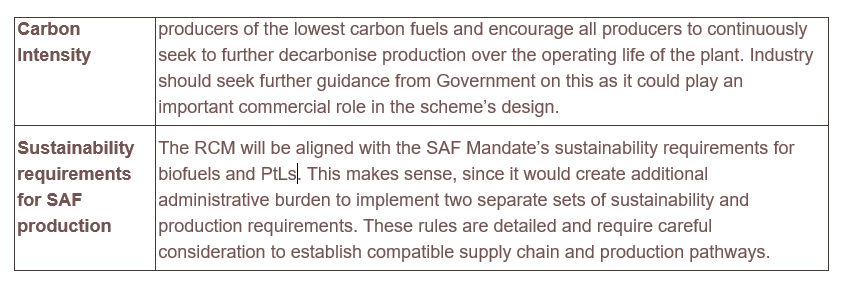
Concluding Remarks and Next Steps
The industry sees the RCM as a crucial piece of the UK’s SAF policy toolkit; giving this nascent industry the revenue certainty required to proceed quickly into project financing and development. Whilst the RCM has been carefully considered by Government and is undoubtedly a positive step for the SAF industry, continued engagement between industry stakeholders and Government will be required throughout 2026 to ensure that the details of the RCM contract allow the sector to “take-off” in the manner intended.
The King & Spalding Energy Team supports clients on all aspects of SAF project development, offtake, financing, regulations and subsidy support. We would be delighted to further discuss any aspect of this note or your project.
Authors

Frederick Lazell
Counsel
Corporate

Matt J. Hardwick
Partner
Corporate

Dan Giemajner
Partner
Corporate
Explore King & Spalding

Capabilities
Low Carbon & Alternative Fuels
Capabilities
Environmental, Health & Safety

The Best and Latest Insights
All in One Place.