



Partner
Article
Venezuela Business Risks and Regulations
January 27, 2026

Barry Kamar
Partner
The removal of former Venezuelan president Nicolás Maduro and recent announcements regarding plans to reinvigorate the development of the country’s natural resources have given rise to significant interest among private sector energy players to participate.
Although these developments create opportunities, U.S. restrictions and sanctions with respect to Venezuela have not eased. Companies engaging in activities linked to Venezuela continue to face layered regulatory risks, including:
- Civil and criminal exposure under the U.S. Anti‑Terrorism Act (ATA) (18 U.S.C. § 2333) for lending direct or indirect “material support” to drug cartels and other actors that have been designated as Foreign Terrorist Organizations (FTOs);
- Civil and criminal exposure under U.S. sanctions laws pursuant to the International Emergency Economic Powers Act for dealings with sanctioned or “blocked” parties, including the Government of Venezuela, Petroleos de Venezuela, S.A. (PdVSA), and Specially Designated Nationals (SDNs);
- Bank Secrecy Act (BSA)/Anti Money Laundering (AML) programs, due‑diligence, and Suspicious Activity Report (SAR) obligations in an opaque banking sector; and
- U.S. Foreign Corrupt Practices Act (FCPA), anti‑bribery and books‑and‑records risk in an environment where public corruption has long been endemic.
In evaluating opportunities, companies should assess their compliance programs and diligence policies and consider steps to improve internal practices relevant to doing business in such a complex environment. Improving these processes now will better position businesses to avoid or defend against government investigations and civil litigation as they take advantage of business opportunities in Venezuela.
Current Regulatory Challenges
The U.S. Government has maintained its use of terrorism, corruption, and sanctions tools against Venezuelan actors and networks such that any foreign investment or activity in Venezuela runs a risk of interactions with restricted parties. Such U.S. legal restrictions are based on designations stemming from a variety of regulations.
U.S. Sanctions
Even following the actions to remove Maduro in early 2026, the U.S. Department of the Treasury’s Office of Foreign Assets Control (OFAC) continues to maintain significant sanctions on Venezuela, including targeted sanctions against certain individuals and entities, expanded designations against the Government of Venezuela, and sectoral sanctions primarily impacting the oil and gold industries.1
Executive Order (E.O.) 13884 blocks all property and interests of the Government of Venezuela, which includes the Central Bank of Venezuela and state-owned oil company PdVSA, that are in the United States or controlled by U.S. persons. The United States has also designated several individuals and entities on its Specially Designated Nationals (SDN) List, including Interim President Delcy Rodriguez and several other government officials associated with the Maduro regime. U.S. persons are prohibited from dealing with blocked entities absent authorization from OFAC. Importantly, under OFAC’s 50 Percent Rule, any entity owned 50 percent or more, directly or indirectly, individually or in aggregate by one or more blocked persons is itself blocked—even if the entity is not itself designated on the SDN list. Companies should carefully review counterparties against U.S. restricted parties’ lists, including OFAC’s SDN List, and assess beneficially ownership of all parties involved in a transaction to ensure compliance with U.S. sanctions.
Sanctions violations may result in significant civil and criminal penalties. Non-U.S. persons can also be subject to secondary sanctions for engaging with sanctioned parties or operating within the Venezuelan oil sector, including providing material assistance, support, or goods and services to the Government of Venezuela.
OFAC provides general licenses authorizing categories of activity that would otherwise be prohibited. OFAC currently maintains limited general licenses under the Venezuela sanctions program. OFAC may also issue specific licenses to authorize particular transactions. Licenses may be time‑limited and conditional. The U.S. Government is currently issuing specific licenses to companies to operate in the oil sector of Venezuela and has indicated that broader sanctions relief in certain sectors is imminent.2
Terrorism-Related Restrictions
In addition, the U.S. Department of Justice (DOJ) has emphasized terrorism‑related prosecutions and reinforced corporate compliance expectations, while Financial Crimes Enforcement Network (FinCEN) has highlighted corruption, transnational criminal organizations, and terrorist financing as national AML priorities.
The U.S. Secretary of State has the authority under 8 U.S.C. § 1189 to designate entities as Foreign Terrorist Organization (FTO). Engaging with a designated entity exposes companies to the risk under the criminal “material support” statute (18 U.S.C. § 2339B) and can create ATA civil exposure. The criminal statute has international reach and broadly prohibits providing “material support” to designated entities. The law defines “material support” broadly, increasing the chance of potential exposure where a corporation may lend such support to an FTO, even without the knowledge of leadership in the United States. OFAC may also designate a person or entity as a Specially Designated Global Terrorist (SDGT) pursuant to E.O. 13224, which triggers asset‑blocking and sanctions prohibitions, which carry significant administrative and criminal penalties for a U.S. person’s transactions with designated entities. FTO and SDGT designations allow civil suits against individuals and entities under the ATA.
Under the ATA aiding‑and‑abetting standard articulated by the Supreme Court in Twitter v. Taamneh, civil liability may attach where a defendant knowingly provides substantial assistance to a person who committed an act of international terrorism and the defendant is generally aware of the person’s role in that conduct. The Court held that there did not need to be a strict nexus between the assistance provided and the wrongful act by the terrorist and that the aider and abettor need not know all the details of the terrorist activity. A recent decision from the district court in New York shows that plaintiffs may survive motions to dismiss by alleging a defendant’s general awareness that services provided by a financial institution had a role in unlawful conduct from which terrorist acts were foreseeable—especially when the defendant’s AML/sanctions controls were deficient. Financial institutions, money-services businesses, and emerging payments firms face acute risk of treble-damages suits under the ATA.
In February 2025, the Department of State designated “Tren de Aragua” (TdA) as an FTO (8 U.S.C. § 1189) and Treasury designated the group as a SDGT pursuant to E.O. 13224, citing TdA’s transnational violence, kidnappings, extortion, bribery of officials, and assassinations across South America. This designation broadly prohibits U.S. persons from providing material support to TdA (18 U.S.C. § 2339B) and triggers collateral enforcement tools that reach financial and commercial facilitation.
In November 2025, the Department of State also designated the Cartel de los Soles as an FTO. Treasury previously designated it under E.O. 13224 for materially supporting FTOs including TdA and Mexico’s Sinaloa Cartel. These designations by the Department of State block property, bar transactions by U.S. persons, and expose violators to severe civil and criminal penalties.
According to the State Department and Treasury, Cartel de los Soles includes networks of current and former Venezuelan military officers and government officials, leveraging state platforms for protection and logistics. The Department of Justice unsealed its December 2025 superseding indictment charging Maduro in January 2026. In it, DOJ alleges that: “[p]owerful Venezuelan elites enrich themselves through drug trafficking and the protection of their partner drug traffickers. The profits of that illegal activity flow to corrupt rank-and-file civilian, military, and intelligence officials, who operate in a patronage system run by those at the top-referred to as the Cartel de Los Soles or Cartel of the Suns, a reference to the sun insignia affixed to the uniforms of high-ranking Venezuelan military officials.”3 Investigative reporting further describes operational ties between Cartel de los Soles and other sanctioned terrorist organizations, including U.S.-designated FARC factions, which ties compound material-support, sanctions-evasion, and due-diligence risks.4
The Venezuelan government denies that Cartel de los Soles exists. Public reporting indicates that the Cartel de los Soles lacks a formal structure, with some experts describing it more as a “a system of widespread corruption” than an organization.5 The Department of Justice’s December 2025 Maduro indictment was filed after the FTO designation of Cartel de los Soles, but in the indictment the group is not referenced as an FTO—indicating that prosecutors chose not to take on the burden of proving the elements of an FTO-related offense at trial. The nature of the Cartel de los Soles raises significant questions about which Venezuelan military, government, and businesses are affiliated with the FTO.
Antibribery Laws
U.S. government reporting describes a general environment in Venezuela in which corrupt officials profit from drug trafficking and the exploitation of commodities.6 The FTO-designated Cartel de los Soles allegedly embedded within the Venezuelan military and government apparatus heightens the risk that payments to obtain licenses, customs clearances, security, or local access will be routed to corrupt officials, their proxies, or sanctioned intermediaries. FCPA investigations connected to drug cartels are one of DOJ’s focus areas under its June 2025 FCPA Guidance.7
Sector-Specific Considerations
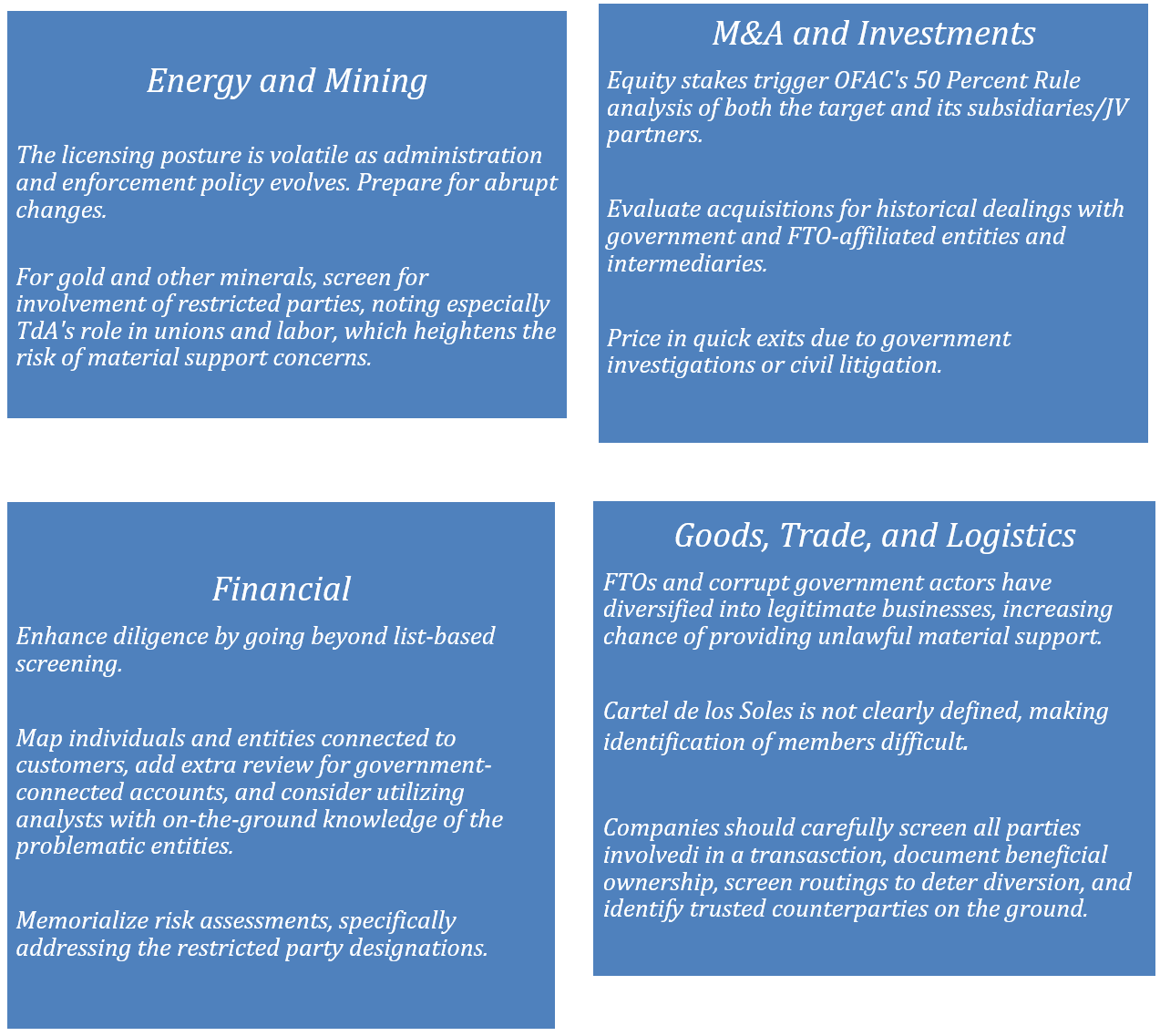
Practical Risk‑Management Takeaways
As businesses analyze the evolving facts on the ground in Venezuela, developing U.S. policy priorities, and potential opportunities, there are some risk-management steps they should consider to better position themselves:
- Training: Update existing FCPA and anti-bribery training to capture the impact of the FTO designations. Consider additional training and signed acknowledgements of U.S. trade control obligations (e.g., sanctions, FTO, and FCPA) by on-the-ground management or intermediaries working in Venezuela.
- Controls: Enhanced controls, including possible suspensions, where (i) direct value transfers to FTO/SDN/blocked parties cannot be precluded; (ii) OFAC licensing may be required, but has not yet been obtained; (iii) ownership/control determinations of opposite parties raises unresolved questions; or (iv) repeated unresolved red flags persist in port/security/logistics layers.
- Payment architecture: Financial entities should consider enriched messages with fund transfers that contain full originator/beneficiary data and purpose; allow lists for vetted government‑adjacent transactions; and block/reject lists where destination and end-user risk cannot be ruled out.
- Documentation: Consider maintaining contemporaneous records of risk assessments, license dependence, screening and resolution steps, and board/management reporting.
- Privileged assessments: Consider assessing current policies and procedures under the attorney-client privilege, identifying any areas or specific incidents that may require a deeper privileged investigation.
King & Spalding will continue to closely watch the legal and political developments impacting U.S. and international business interests in Latin America as the Administration moves to implement its strategy focused on the Western Hemisphere.
Authors

Brandt Leibe
Partner
Special Matters & Government Investigations
Barry Kamar
Partner
Special Matters & Government Investigations
Explore King & Spalding

Capabilities
Energy

Capabilities
Special Matters & Government Investigations

The Best and Latest Insights
All in One Place.