



Partner
Article
Medicare and Medicaid Demos Seek to Impose MFN Pricing: An Overview of GENEROUS, GLOBE, and GUARD
December 29, 2025
On May 12, 2025, President Trump issued an Executive Order entitled “Delivering Most-Favored-Nation Prescription Drug Pricing to American Patients”1 in which he instructed his Administration to create plans to impose most favored nation (“MFN”) pricing on drug manufacturers. The Executive Order was virtually silent on how MFN would apply to the Medicare program given the complex and detailed drug pricing laws enacted by Congress over the past 35 years.
On December 19, 2025, the Centers for Medicare & Medicaid Services (“CMS”) released two MFN drug pricing proposed rules: the “Global Benchmark for Efficient Drug Pricing” (“GLOBE”) and “Guarding U.S. Medicare Against Rising Drug Costs” (“GUARD”) models. If adopted, these rules would implement new, mandatory drug rebate schemes for select drugs in Medicare Parts B and D, respectively.2 These proposals augment a third recently announced, voluntary model called “GENErating cost Reductions fOr U.S. Medicaid” (“GENEROUS”) under which participating manufacturers would pay MFN-based supplemental rebates for Covered Outpatient Drugs (“CODs”) dispensed to Medicaid patients, in exchange for standardized coverage criteria in participating states.3 The GLOBE, GUARD, and GENEROUS models form a trio of alternative payment demonstrations intended to bring prices for drugs in the United States more in line with those in other developed countries.
Both the GLOBE and GUARD proposed rules and the GENEROUS Request for Applications (“RFA”) are long and extremely detailed. We provide in this alert high-level summaries of each.
There are important variations among the programs, and distinct implications for differently situated manufacturers when determining how they should respond to the GLOBE and GUARD proposals and decide whether to participate in GENEROUS.
Public comments on the GLOBE and GUARD proposed rules must be submitted by February 23, 2026, and manufacturers must apply to participate in the GENEROUS Model by March 31, 2026. We urge all stakeholders to consider the impact of these demonstration projects on their operations and submit comments on the proposals. We look forward to assisting you in interpreting and raising questions about the proposals and RFA, as well as drafting and submitting public comments to CMS on the proposed rules.
King & Spalding will host a webinar on January 8, 2026 at 1 pm ET to discuss the models in detail. We invite you to join an in-depth discussion of these intricate and impactful regimes.
Brief Summaries of the Announced and Proposed Models
1. Medicaid “GENEROUS” Model – Payment of Voluntary MFN-Based Supplemental Rebates in Exchange for Standardized COD Coverage Criteria
On November 6, 2025, CMS announced a 5-year, voluntary initiative to streamline the use of MFN prices in state Medicaid programs. The GENEROUS model was likely compelled by the agreements the White House negotiated with 14 different manufacturers in which the companies agreed to offer MFN prices to state Medicaid programs through supplemental rebate agreements starting in 2026. To implement these agreements, the GENEROUS model creates a marketplace for states and manufacturers to meet to negotiate the supplemental rebate agreements using CMS-created, standardized coverage criteria and pricing metrics. Under the GENEROUS model, manufacturers would offer supplemental rebates to state Medicaid programs for included drugs at MFN prices. Importantly, however, and in contrast to the proposed GUARD and GLOBE models, MFN prices would be identified based on the net price of the second lowest of eight peer countries, adjusted by gross domestic product (“GDP”) using a purchasing power parity (“PPP”) method. If the states and the manufacturers reach agreement, individual state Medicaid agencies would then use the CMS-created criteria to develop their Preferred Drug Lists (“PDLs”) and for utilization management of the CODs.
Participating manufacturers will provide MFN pricing on CODs in the model in the form of a supplemental rebate paid by the manufacturer to participating states. States could continue to seek supplemental rebates outside the model for CODs for which the state is not accessing the MFN for a COD under the model.
2. Medicare “GLOBE” Model – Mandatory MFN-Based Rebates for Select Part B Drugs Furnished to a Subset of Beneficiaries
In the GLOBE Model proposed rule, CMS proposes to test whether an alternative to the Medicare Part B Inflation Rebate Program that uses a benchmark derived from international pricing information instead of the current domestic, inflation-based benchmark to calculate rebates for certain drugs and biologicals would reduce costs for the Medicare program and fee-for-service (“FFS”) beneficiaries while preserving the quality of care.
The proposed model would be a 7-year demonstration beginning on October 1, 2025. Rebates would be payable to HHS for GLOBE Model drugs4 that are furnished to eligible beneficiaries in specific, randomly selected geographic areas representing 25% of the Medicare B population. Rebates would be due only on dispenses of the drugs to GLOBE Model beneficiaries – individuals enrolled in traditional Medicare Part B (but not Medicare Advantage) as their primary payer that have an address in a GLOBE Model geographic area. GLOBE, harnessing the Inflation Reduction Act’s (“IRA”) Inflation Rebate program – would require manufacturers to pay to CMS rebates based on the amount by which a GLOBE Model benchmark for a selected drug (based on international pricing in a basket of 19 reference countries)5 exceeds the inflation rebate amount under the Part B Inflation Rebate program.
CMS would determine the GLOBE Model benchmark amount used to calculate GLOBE Model rebates using the higher of:
- The per unit Method I GLOBE Model benchmark– calculated as the lowest per unit GDP (PPP) adjusted country-level price using public and proprietary international drug pricing information available to CMS (that meets requirements the agency is proposing) for the applicable calendar quarter; or
- The per unit Method II GLOBE Model benchmark – calculated as the across-country volume-weighted average GDP (PPP) adjusted net price per HCPCS billing unit for the applicable calendar quarter, calculated using manufacturer-submitted data.
CMS would calculate the per unit Globe Model Rebate as the difference between the drug’s “specified amount” (typically average sales price (“ASP”) or wholesale acquisition cost (“WAC”)) for an applicable quarter and the GLOBE Model benchmark amount (assuming this amount is higher than the Part B Inflation Rebate amount that would otherwise apply). The GLOBE Model Rebate for a drug for an applicable quarter would be the per unit GLOBE Model Rebate multiplied by the number of GLOBE Model billing units for the drug.
For purposes of the GLOBE Model test, CMS would identify a “comparison group” of beneficiaries who meet the criteria to be GLOBE Model beneficiaries but who do not have an address of record in a GLOBE Model geographic area.
3. Medicare “GUARD” Model – Mandatory MFN-Based Rebates for Select Part D Drugs Furnished to a Subset of Beneficiaries
In the GUARD Model, CMS proposes to test whether changing the Part D Inflation Rebate Program to calculate rebates based on MFN pricing benchmarks for certain drugs and biologicals would reduce program spending for Medicare while preserving or enhancing the quality of care for Medicare beneficiaries. The proposed GUARD Model design is similar in many respects to the proposed GLOBE Model design but would include different therapeutic categories of drugs with rebates calculated annually, rather than quarterly.6 The GUARD model would also be a 7-year demonstration proposed to begin on January 1, 2027.
Rebates would be payable to HHS for GUARD Model drugs that are furnished to eligible beneficiaries in specific, randomly selected geographic areas representing 25% of the Medicare D population. Rebates would only be owed for GUARD Model drugs furnished to GUARD Model beneficiaries – individuals enrolled in a Part D plan (a standalone prescription drug (“PDP”) or a Medicare Advantage prescription drug (“MA-PD”) plan) but not an Employer Group Waiver Plan (“EGWP”), that have an address in a GUARD Model geographic area.
Like GLOBE, GUARD would also utilize the higher of two benchmarks – one calculated as the lowest price of the same basket of 19 reference countries using international pricing data available to CMS and another set as the across-country average net price for the basket of reference countries, calculated using manufacturer-submitted pricing data. CMS would calculate a per unit GUARD Model rebate amount as the difference between the performance year Medicare net price for a GUARD Model drug and the GUARD Model applicable international benchmark. The total GUARD Model Rebate amount for a GUARD Model drug would be the per unit GUARD Model Rebate amount multiplied by the number of units of the GUARD Model drug dispensed under Part D and covered by Part D plan sponsors for GUARD Model beneficiaries.
Like the GLOBE Model test, CMS would identify a “comparison group” of beneficiaries who meet the criteria to be GUARD Model beneficiaries but who do not have an address of record in a GUARD Model geographic area.
Details
1. Timing Considerations
Below are the significant dates for each of the Models for comparison purposes.
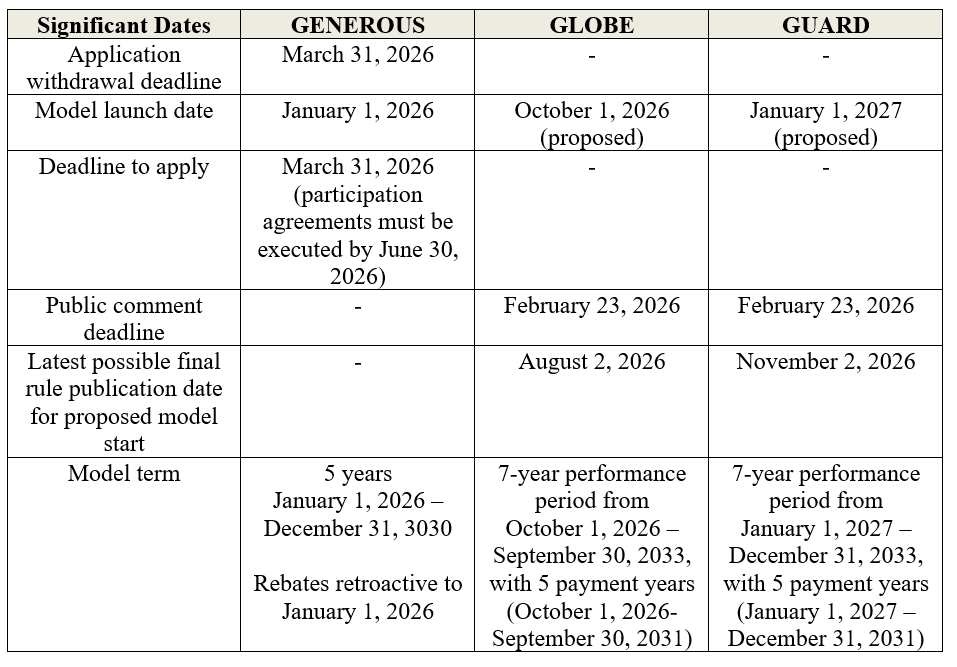
The GENEROUS Model would require participating manufacturers to provide MFN rebates for CODs in the model, retroactive to January 1, 2026. The “pre-implementation application period,” during which CMS and manufacturers negotiate the standard coverage criteria for each of the CODs, began on November 10, 2025 and ends March 31, 2026. If a manufacturer submits an application but wishes to withdraw, it may do so by March 31, 2026. If an agreement is reached, the manufacturer must enter into a participation agreement by June 30, 2026.
The GLOBE Model proposed start date is October 1, 2026. The latest CMS could issue a final rule that would be effective on that date (allowing for the 60-day delayed effective date required by the Congressional Review Act (“CRA”)) is August 2, 2026. This means that businesses will need to decide whether to participate in the GENEROUS Model – and disclose detailed international pricing data – by March 31, 2026, well before they know the final design of the GLOBE Model.
The GUARD Model has a later proposed model start date of January 1, 2027 to follow the calendar year Part D Plan year cycle. The latest CMS could issue a final rule that would be effective on January 1, 2027 (allowing for the 60-day delayed effective date required by the CRA) is November 2, 2026, also well after the deadline of March 31, 2026 to decide whether to participate in the GENEROUS Model. Also, given the different proposed start dates for the GLOBE and GUARD Models, manufacturers could be required to begin paying rebates under the GLOBE Model before knowing the final design of the GUARD model.
2. Affected Drugs
GENEROUS:
GENEROUS-included drugs are all of a participating manufacturers’ single source and innovator multiple source drugs under all of a manufacturer’s associated labeler codes listed in the Medicaid Drug Rebate Program (“MDRP”). A “model drug” is defined at the level of the NDC-9.
CODs included in the Innovation Center’s Cell and Gene Therapy model will not be included in the GENEROUS model.
GLOBE and GUARD:
The GLOBE and GUARD rules propose the following criteria for drugs that would be included in each of the Models.
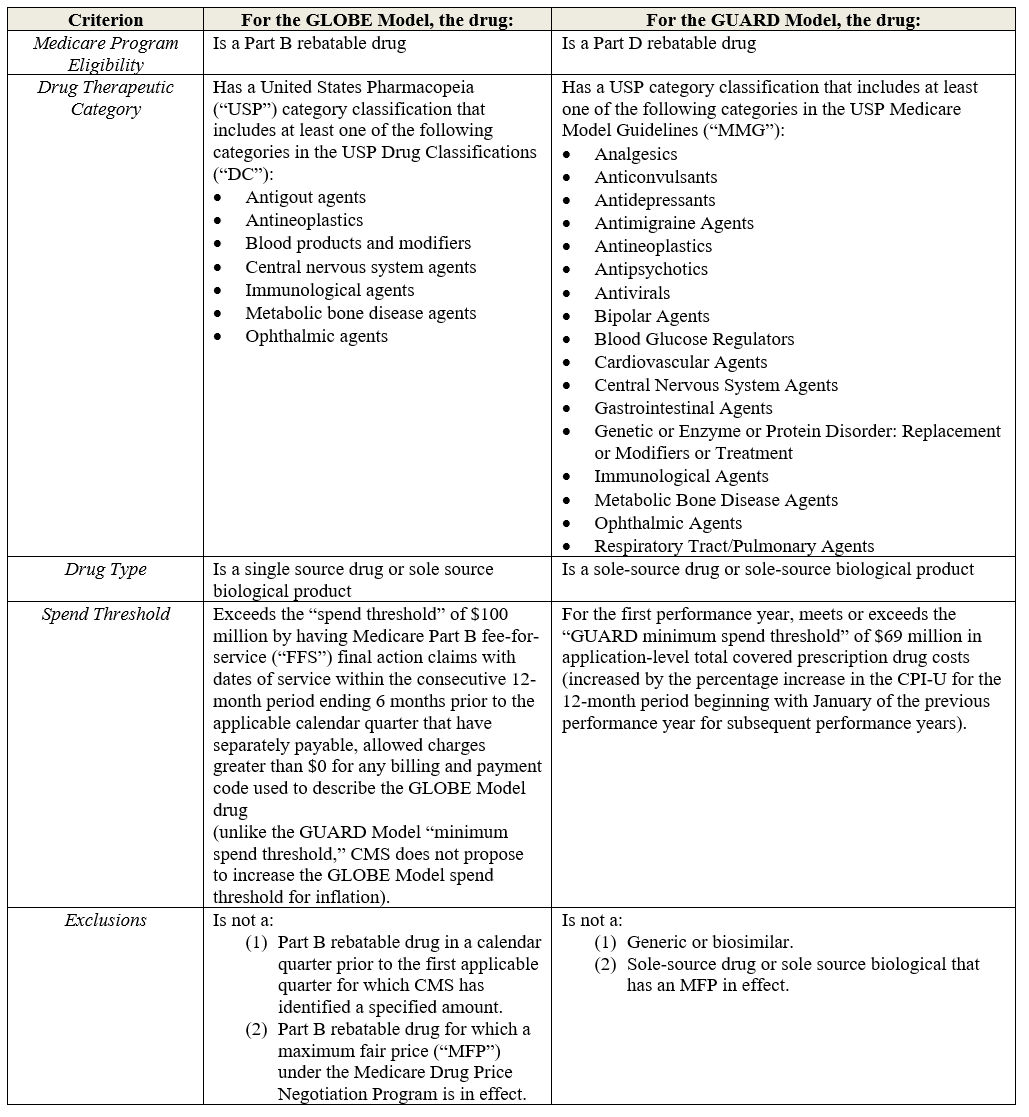
How CMS would use the USP DC and USP MMG to identify qualifying drugs for the GLOBE and GUARD Models, respectively, is not entirely clear. Neither classification system defines the drug categories it uses, and it is not clear from CMS’s proposals how it would treat drugs that fall into one category but are used for different indications. Would such drugs be included in the Models whenever they are used, or only when used for a qualifying indication? How would such a policy be implemented in practice, such as when indications are added over time? Comments could ask CMS to establish a procedural mechanism to determine or challenge how individual products are categorized.
3. Different Reference Country Baskets for “Most Favored Nation” Calculations
The Models define the baskets of reference countries differently. GENEROUS (and the MFN agreements with which we are familiar) utilizes a basket of eight countries (the G-7 countries minus the U.S. plus Denmark and Switzerland).
GLOBE and GUARD, on the other hand, would use the set of 19 reference countries that are non-U.S. Organization for Economic Co-operation and Development (“OECD”) as of October 1, 2025 with: (1) a real GDP per capita at least 60 percent of the U.S. real GDP per capita; and (2) an annual real GDP that is at least $400 billion. CMS explains that the real GDP per capita for a country is the most recent estimate of real GDP per capita based on purchasing power parity (“PPP”). CMS proposes for both Models that the set of reference countries would remain the same through the 5-year Model performance periods. The GLOBE and GUARD lists include the eight GENEROUS countries.
GENEROUS versus GLOBE & GUARD Reference Countries:
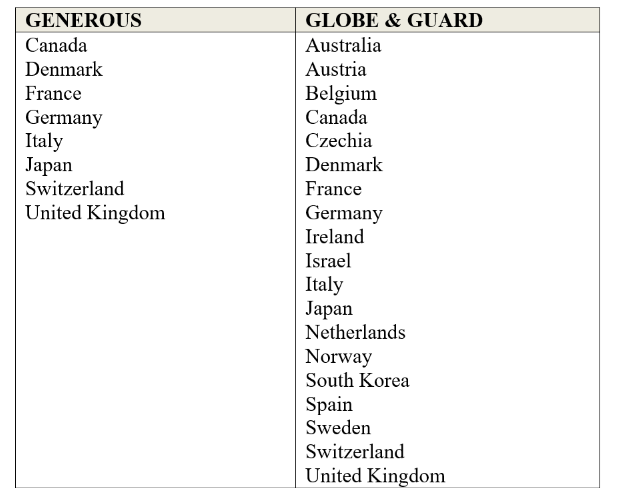
CMS did not explain why it selected the basket countries it will use in the GENEROUS Model. In the GLOBE and GUARD proposed rules, CMS said that it believes “applying a minimum of 60 percent of U.S. (PPP)-adjusted per capita GDP and a minimum $400 billion (PPP)-adjusted aggregate GDP strikes a balance between having too low (PPP)-adjusted per capita GDP and (PPP)-adjusted aggregate GDP thresholds and including data from countries with economies that are substantially different from the United States, while also not having such high (PPP)-adjusted per capita GDP and (PPP)-adjusted aggregate GDP thresholds that the set of reference countries would be very small.” Yet, despite this statement, CMS in November chose a different and smaller basket of reference countries. It is possible CMS will amend the proposed GLOBE/GUARD reference basket to more closely align with the more targeted GENEROUS list in the final rules.
4. Inconsistent Calculations of MFN Prices to Calculate Model Rebates
The Models would not calculate MFN prices for purposes of calculating rebates using a consistent methodology. For instance, the benchmark to calculate the Medicaid MFN price under GENEROUS would be the second lowest country-specific manufacturer-reported net price, adjusted by GDP per capita at PPP.
In contrast, the GLOBE and GUARD Models would utilize the higher of two benchmarks: one set using pricing data available to CMS from public and proprietary sources (which must meet proposed requirements) to determine the lowest per unit GDP (PPP) country level price or another set using pricing data calculated and voluntarily reported by eligible manufacturers to CMS to determine the across country volume-weighted average GDP (PPP) adjusted net price per HCPCS billing unit.
Nowhere in the GLOBE and GUARD proposed rules (or the GENEROUS RFA, or any of the MFN agreements with which we are familiar) does HHS attempt to explain in adequate detail how to calculate net price points in any specified country. What CMS and each manufacturer do with calculated price points from these countries once they are known is more adequately articulated. But details regarding inclusion/exclusion, calculation mechanics, foreign delivery/payment systems, and all other critical calculation criteria are sorely lacking. This lack of specificity on the fundamental price point calculation is deeply troubling, and if finalized as proposed it will present significant False Claims Act risk to manufacturers. We encourage industry to comment aggressively on this topic, and to demand greater clarity for both pricing compliance and government program liability mitigation purposes.
Both GLOBE and GUARD purport to test whether using an alternative rebate calculation based on MFN prices rather than the rate of inflation would save the Medicare program money. It is curious then that CMS proposes to use the higher of an across-country average benchmark when based on manufacturer-reported data versus the lowest per unit GDP country level price when based on data available to CMS. If CMS was seriously testing whether rebates based on MFN prices rather than the rate of inflation would save the program money, it seems the agency should use the lower of the two benchmark amounts. The use of the higher amount seems to illustrate the degree to which CMS is seeking international pricing data from manufacturers.
Indeed, CMS acknowledges that with this proposed policy, it is attempting to encourage manufacturers to report pricing data:
We expect that the per unit Method II GLOBE Model benchmark would tend to be higher than the per unit lowest country-level price identified under our proposed methodology for the per unit Method I GLOBE Model benchmark – before CMS would apply the proposed GDP (PPP) adjuster – because it reflects the price variations in reference countries and accounts for them through a volume-weighted price. As such, we believe this approach would be a strong incentive for manufacturers to conduct data gathering, analyses, and reporting activities related to voluntary manufacturer submission of international drug net pricing data as discussed in section II.G.6. of this proposed rule. Our goal is to encourage manufacturers to report international drug net pricing data (that is reflective of the actual transaction prices internationally) for GLOBE Model drugs to CMS for purposes of the GLOBE Model to enhance the model test and inform CMS’ model monitoring and evaluation activities.
Although voluntarily calculating and reporting pricing data to CMS would likely result in lower rebate liability under the Models if finalized as proposed, manufacturers should be careful about making this commitment. In the GLOBE Model proposed rule, CMS proposed that manufacturers that voluntarily submit international net pricing data must continue to do so for the duration of the GLOBE Model so long as sales of applicable international analogs have occurred.
5. Determination of “Analogous” International Products
CMS proposes to identify non-U.S. analogs in each of the basket countries. The GENEROUS Model RFA does not contain information on this point.
For the GLOBE Model, CMS would define “applicable international analog” to mean a non-US analog the scientific or nonproprietary name, dosage form, and route of administration of which align with a GLOBE Model drug and that are sold in one or more reference countries during the applicable ASP calendar quarter, excluding those identified in their respective country as a generic or biosimilar biological product.
For the GUARD Model, CMS would define an international analog as an international product with an active ingredient, route of administration, dosage form, and strength that aligns with a GUARD Model drug. Why the GLOBE and GUARD models do not propose identical methods of determining analogous products in ex-U.S. markets is a mystery.
For both Models, CMS proposes to go to significant lengths to “adjust” data for international products to “align” international products with GLOBE and GUARD Model drugs. This too should be a point your company may want to comment on – nonspecific “adjustments” to tie U.S. products to foreign analogs strike us as ripe for mischief. We expect the identification of analogous ex-US versions of drugs will be significantly disputed.
6. Use of GDP at PPP
One important aspect of the proposed calculations for all three Models is the use of per capita GDP adjusted by PPP. Although this will not eliminate the disparities from intercountry-differences, PPP provides some adjustment for relative purchasing power after initially standardizing the sizes of different economies for comparative purposes. We believe manufacturers should support the application of PPP, as it provides a more nuanced comparison and should, in almost every instance, increase the MFN price used for comparison to net sales prices.
For each country, CMS proposes to use the real GDP per capita and the annual real GDP based on PPP, as estimated and available in the CIA World Factbook for the year 2024 and available as of October 1, 2025.
7. Implementation of the Models
As noted above, the GENEROUS Model would be implemented through manufacturer participation agreements with CMS and voluntary supplemental guaranteed net unit price (“GNUP”) rebate agreements between manufacturers and state Medicaid programs. Given that supplemental rebate agreements are currently widely in use, most manufacturers will have familiarity with the operations and mechanics of such programs.
In contrast, both the GLOBE and GUARD models harness the new Medicare Inflation Rebate penalty programs created by the IRA. Many manufacturers are still navigating implementation of this new rebate system, and many manufacturers do not have direct experience with the inflation rebates. In brief, however, for GUARD CMS would compare the difference between the manufacturers’ Medicare net price (net of rebates, discounts and price concessions) and the MFN price and would require manufacturers to pay a rebate to the Medicare Part D Trust Fund if the Medicare net price is greater than the MFN price. For GLOBE, CMS would compare the amount by which the ASP (or if not available, the WAC) for a drug exceeds the per-unit benchmark amount (the MFN price) and the amount of any inflation rebate owed (including when $0 inflation rebate is owed). CMS would require the manufacturer to pay the Medicare Part B Trust Fund the larger rebate amount (which is almost always expected to be the MFN amount). Stated differently, CMS through its Innovation Center is bending the rules of the Inflation Rebate program to morph it into an MFN rebate program instead.
Conclusion
If you have questions regarding the Models or would like assistance assessing their impacts or preparing comments, please contact David Farber, John Shakow, Chris Markus, or Katie Cooper. Please also join our upcoming webinar scheduled for January 8, 2026 at 1 pm ET (a calendar invitation will be forthcoming soon for those subscribed to the client alert email).
Authors

David J. Farber
Partner
Government Matters & Regulation

John D. Shakow
Partner
Government Matters & Regulation

Christina M. Markus (Chris)
Partner
Government Matters & Regulation

Katherine Cooper
Counsel
Government Matters & Regulation
Explore King & Spalding

Capabilities
Innovative Drug, Biologic & Device Development
Capabilities
Life Sciences & Healthcare

The Best and Latest Insights
All in One Place.