



Partner
Article
A Breakthrough for Breakthrough Device Coverage?
CMS Releases the RAPID Coverage Pathway Proposed Notice
September 2, 2026

Jessica Ringel
Partner

D. Kyle Sampson
Partner

Todd Tuten
Senior Advisor

Katherine Cooper
Counsel

Bev H. Lorell, M.D. (Beverly)
Consultant
The Centers for Medicare & Medicaid Services (CMS) faces a daunting challenge: how to balance the competing priorities of promoting innovation and protecting Medicare’s fiscal solvency. The agency is charged with both missions - it strives to support beneficiaries’ access to quality care, while doing so on a cost-effective basis. With the proposed Regulatory Alignment for Predictable and Immediate Device (“RAPID”) coverage pathway, CMS appears to take on these two priorities. While this new pathway sounds quite promising, in our view, only those breakthrough devices that truly are a material advance in the standard of care – and otherwise might be hindered by being grouped with inferior technologies – may actually benefit from the RAPID pathway.
On August 7, 2026, CMS released a proposed procedural notice with comment period for the RAPID pathway, which the agency promises will give Medicare beneficiaries earlier access to certain innovative medical devices.1 The Federal Register notice followed simultaneous press releases issued on April 23, 2026, in which CMS and the U.S. Food and Drug Administration (“FDA”) announced the pathway. 2 CMS is accepting public comments on the proposed notice through October 13, 2026.
RAPID is intended to replace the current Transitional Coverage for Emerging Technologies (“TCET”) pathway and give Medicare beneficiaries expedited access to certain Class II and Class III devices that FDA designates as breakthrough devices. CMS and FDA would collaborate with manufacturers who express interest in the voluntary pathway to determine if their device is eligible and to ensure device studies are designed to demonstrate positive health outcomes for the Medicare population. For devices that do, CMS would release a proposed National Coverage Determination (“NCD”) the same day the device receives FDA market authorization (provided the relevant FDA Decision Summary or Summary of Safety and Effectiveness (“SSED”) is available). Final NCDs would be issued 60 days later for Class II devices and 90 days later for Class III devices.
Because FDA’s marketing authorization decisions do not require that a device meet the standard for Medicare coverage – that the device is reasonable and necessary for the diagnosis or treatment of an illness or injury for individuals in the Medicare population3 – the RAPID coverage pathway would address “gaps in research about health outcomes specific to the Medicare population” by “providing manufacturers with information on the specific outcomes needed to support Medicare NCDs much earlier in the process.”4
The RAPID proposal follows 15 years of similar experiments by FDA and CMS to coordinate device approval and Medicare coverage, including the “parallel review” program, the current TCET program, and others. In our experience, very few products have made it through these regulatory gauntlets, and the programs themselves in many cases have been limited to only a few products due to CMS resource and staff limitations. While the RAPID notice mentions these programs, there is insufficient programmatic change in the proposal for the authors to be confident that the RAPID program will be any more effective in advancing coverage for breakthrough devices than its predecessor programs. Notably, the announcement assumes, without material scientific evidence, that all breakthrough devices work differently in Medicare beneficiaries than the general population.
That said, the RAPID pathway appears to include a fundamental shift in the NCD process that will move to product-specific coverage policies, rather than policies addressing an entire therapeutic class of products. Thus, despite questions about whether the program will slow down the FDA approval process, the RAPID program may be beneficial for those breakthrough devices that truly improve the standard of care, and that otherwise would be lumped into an NCD with prior ineffective products.
Devices Eligible for the RAPID Coverage Pathway
To be eligible for RAPID, a device must be:
- A presumptive Class II FDA Breakthrough-designated device participating in FDA’s Total Product Life Cycle Advisory Program (“TAP”) planning to submit a De Novo request to FDA or a Class III FDA Breakthrough-designated device planning to submit a premarket approval application (“PMA”) regardless of whether it is participating in TAP.
- In the Investigational Device Exemption (“IDE”) pre-submission stage with a planned IDE study that will enroll Medicare beneficiaries and evaluate clinical outcomes that FDA determines are appropriate for the device.
- One that can be billed to Medicare, if approved.
The following devices would not be eligible for RAPID:
- Devices that would not fall within a Medicare benefit category.
- Devices already subject to a controlling NCD.
- Devices otherwise excluded from coverage by law or regulation.
- In vitro diagnostic (“IVD”) products, such as diagnostic lab tests, which CMS explains have historically been subject to coverage determinations by specialized Medicare Administrative Contractors (“MACs”).
The RAPID Process
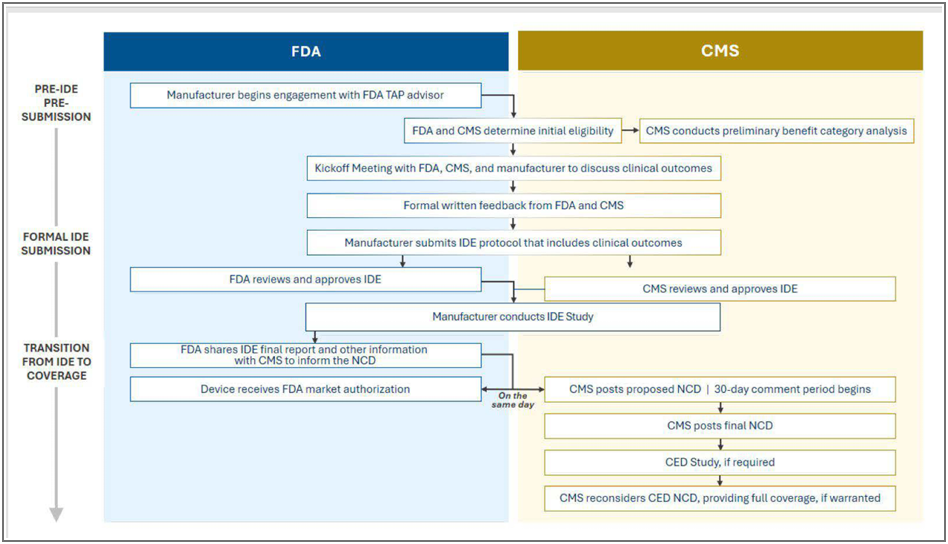
Where a manufacturer expresses interest in the voluntary RAPID coverage pathway and CMS and FDA determine their device is eligible, the manufacturer will have additional opportunities to engage with the agencies (after agreeing that information will be shared between FDA and CMS).
a. Pre-IDE Submission Engagement
- At a kick-off meeting with FDA and CMS, the manufacturer will discuss a clinical study synopsis the manufacturer prepared with assistance from FDA that explains how the manufacturer will address FDA and CMS regulatory requirements, with an opportunity for the agencies to provide real-time feedback on the IDE study protocol at the meeting.
- The manufacturer will submit to FDA a written request for feedback on the IDE study protocol, which FDA will review with CMS. CMS will provide written feedback on the study protocol, including whether the health outcomes the study will evaluate would be sufficient to support an NCD or satisfy IDE criteria, along with feedback on any other issues that should be addressed.
- FDA will continue to provide feedback, which will include written comments from FDA and CMS, through its normal processes. This feedback will identify potential evidence gaps for manufacturers to address in their planned pivotal IDE study or potential postmarket studies.
b. Post-IDE Submission Engagement
- While the FDA will review the manufacturers’ IDE application using the normal process, including issuing a decision letter that will identify any study design considerations (SDCs), CMS will communicate with the manufacturer about the SDCs that must be addressed to remain in the RAPID coverage pathway, allowing manufacturers to address CMS concerns in the premarket phase.
- Assuming all IDE and RAPID requirements are met, CMS will send the manufacturer a letter indicating the agency’s intent to issue an NCD on the same date as FDA marketing authorization.
c. Transition to Coverage
Once the IDE study is completed and the manufacturer submits the marketing submission to FDA, CMS will be notified and will receive the study report and information necessary to “confirm if the device has demonstrated an improvement in the clinical outcomes that FDA has determined are appropriate for the device and which CMS has confirmed is a qualifying health outcome for purposes of Medicare coverage.” If the manufacturer wishes to pursue an NCD through the RAPID coverage pathway, it will submit a formal NCD request to CMS and may submit additional materials to support the NCD. CMS will initiate the NCD process by posting a tracking sheet and proposed NCD on the CMS website on the same day as FDA market authorization (assuming the FDA Decision Summary or SSED are publicly available).
National coverage under the RAPID pathway will be limited to the FDA-authorized indication(s) for the device. RAPID NCDs may be more “streamlined” and include “more concise evidence summaries” than conventional NDCs. If there is insufficient evidence for Medicare coverage under section 1862(a)(1)(A) (the reasonable and necessary standard), CMS may issue the proposed NCD under the coverage with evidence development (“CED”) framework. Manufacturers of devices for which CMS pursues the CED framework should remain engaged with their FDA TAP advisor and CMS point of contact to ensure evidence gaps are addressed.
The proposed notice includes the following illustration of CMS and FDA’s roles in RAPID:
Other Pathways
- TCET Pathway: In the press release announcing RAPID, CMS said it was pausing the TCET Pathway for new devices to focus on “successful implementation of the RAPID coverage pathway.”5The proposed notice indicates TCET will be paused for new candidates as of the date of its publication.6
- Parallel Review: Parallel Review, another expedited coverage pathway, applies to non-breakthrough devices and will remain available. According to the proposed notice, “CMS intends to work with FDA to consider updates” to that and other programs to align the agencies’ procedures.7
Considerations for Manufacturers
While the proposed RAPID coverage pathway sounds promising, manufacturers should consider whether the added effort to participate would benefit their companies. For the following reasons, RAPID might be less appealing than it sounds:
- Although devices that successfully navigate the RAPID process with FDA are promised a proposed NCD the same day as marketing authorization, the requirement that a device “demonstrates improvement” in a “qualifying health outcome for purposes of Medicare coverage” is not defined. Further, being accepted into the RAPID program promises only CMS review of study design and materials. It does not guarantee national coverage if a device fails to meet CMS’s performance expectations in the Medicare population.
- Even if a device receives national coverage through the RAPID pathway, the temporary additional Medicare payments that have been available for breakthrough devices are ending. CMS finalized its proposal to repeal the alternative Inpatient Prospective Payment System (“IPPS”) New Technology Add-on Payment (“NTAP”) and Outpatient Prospective Payment System (“OPPS”) Device Pass-through pathways, under which qualifying breakthrough devices were not required to demonstrate substantial clinical improvement to qualify for separate payment.8New technologies designated as breakthrough devices by September 30, 2026 will be grandfathered into the old policy, but all other devices will be required to meet the substantial clinical improvement criterion. Without making this showing, which is notoriously difficult, payment for devices that receive national coverage through RAPID will be bundled with payment for the associated procedure under the IPPS and OPPS, removing an important incentive for hospital adoption of new devices.
- Manufacturers should carefully consider whether an NCD for their device would be more advantageous than coverage at the local level (on a MAC-by-MAC or a claim-by-claim basis).
- If CMS cannot address the total number of NCDs using available resources, the agency would prioritize opening RAPID NCDs over non-RAPID NCDs from the NCD Wait List. Given CMS resource limitations, manufacturers should have reasonable expectations about how much time the RAPID coverage pathway would save them. For manufacturers of devices seeking NCDs that are not eligible for RAPID, wait times for coverage could be even longer than expected.
In addition to the above, manufacturers should take into consideration three other concerns – one legal, one scientific, and one procedural. On the legal side, a significant feature of the RAPID program is the CED program, in which CMS can decline coverage in an NCD except for Medicare beneficiaries participating in a further clinical trial created and defined by CMS (not FDA). The CED process, in our view, is of suspect legality, and an HHS General Counsel Opinion from the first Trump Administration, subsequently withdrawn,9 has persuasive weight. Further, while CMS in the notice promises that CEDs will be efficiently run and will have appropriate termination dates, CMS has failed for the past 20 years to deliver on that promise.10
Addressing the scientific issue, CMS’s operating principle driving the RAPID program (and the CED process) is that medical devices work differently in the Medicare population than they do in the general population. While differences no doubt exist, this broad claim by CMS, reinforced by the writings of agency officials,11cannot be extrapolated to any specific medical device. We believe that the agency should be more cautious in its assertions, particularly without the very medical evidence that CMS itself believes is needed for the RAPID program.
Third, the agency only briefly addresses the issue of its limited resources, which have severely constrained the NCD program for decades. The prior TCET program was limited to five devices per year,12 and even then, did not produce a meaningful number of breakthrough device NCDs. While CMS promises to move RAPID NCDs to the front of the line, that may be problematic for a long list of NCDs and NCD reconsideration requests currently pending in which beneficiary health is very much at stake. Nor is there a reason to believe that the CMS Coverage and Analysis Group, which is currently short-staffed, will have the resources necessary to effectively manage the program.
One final note – notwithstanding these challenges, one important shift in the proposed RAPID model could materially benefit one group of breakthrough device manufacturers. Historically CMS has always issued NCDs based upon an analysis of all devices or treatments in a therapeutic class. The result of this policy was that new technologies representing a material improvement in the standard of care were often lumped together with older treatments and subject to non-coverage decisions. Through RAPID, CMS appears to now be shifting to product-specific NCDs, which would allow affected breakthrough devices to shed the historic baggage of prior failed treatments. It is these breakthrough products – those that truly are a material advance in the standard of care – that actually may benefit from the RAPID pathway.
King & Spalding LLP regularly counsels drug and device manufacturers on strategies for Medicare coverage, coding, and payment for new and existing technologies. Please contact us if you have any questions about the RAPID coverage pathway or other aspects of Medicare reimbursement or would like assistance preparing public comments on the proposed procedural notice.
Authors

David J. Farber
Partner
Government Matters & Regulation
Jessica Ringel
Partner
Government Matters & Regulation
D. Kyle Sampson
Partner
Government Matters & Regulation
Todd Tuten
Senior Advisor
Government Matters & Regulation
Katherine Cooper
Counsel
Government Matters & Regulation
Bev H. Lorell, M.D. (Beverly)
Consultant
Government Matters & Regulation

Emily Silverberg
Consultant
Government Matters & Regulation
Explore King & Spalding

Capabilities
FDA & Life Sciences

The Best and Latest Insights
All in One Place.